Wednesday, June 24, 2015

The Vatican

After our fabulous tour of the Colosseum and the Roman Forum on Monday and we're excited to have our tour of the Vatican Museum, Sistine Chapel, and St. Peter's Basilica.  Our tour guide today is also named Barbara so it will be easy to remember her name.  Originally, we were to have Francesca as our guide for both days, but she was sick so the need for last minute replacements.

The Vatican is a separate sovereign nation, surrounded by Rome, but not a part of Italy.  Located on the other side of the Tiber River from most of the famous sites in Rome, it's a too far to walk from our hotel so we took the Metro over and met Barbara at 9:00 in front of the entrance to the Vatican Museums.  Fortunately, we booked our tickets and tour time on line or else we'd be standing in an extremely long line outside waiting to buy tickets to get in.

Standing in St. Peter's Square in front of the Basilica.
The Sistine Chapel is the brown building in the upper right.
Most of us non-Catholics know the Vatican as the home of the Pope and the seat of the Catholic Church. St. Peter's Basilica is the largest church in the world.  What I think most people don't know is the Vatican has a treasure trove of antiquities, historical documents, and priceless works of art.  Barbara walked us through centuries of world and religious history and art -- both mind-boggling and fascinating to see all of this in one place.

Without a doubt, the highlight of the tour was seeing the Sistine Chapel.  Painted by Michelangelo over a period of four years, it is considered my many to be one of his crowning achievements.  To sum it up -- awe-inspiring.  To think that he was able to paint at this detail and scale in the early 1500s and it still remains today is simply incredible.  Unfortunately, you are not allowed to take photos so I will have to make do with mental images and postcards.

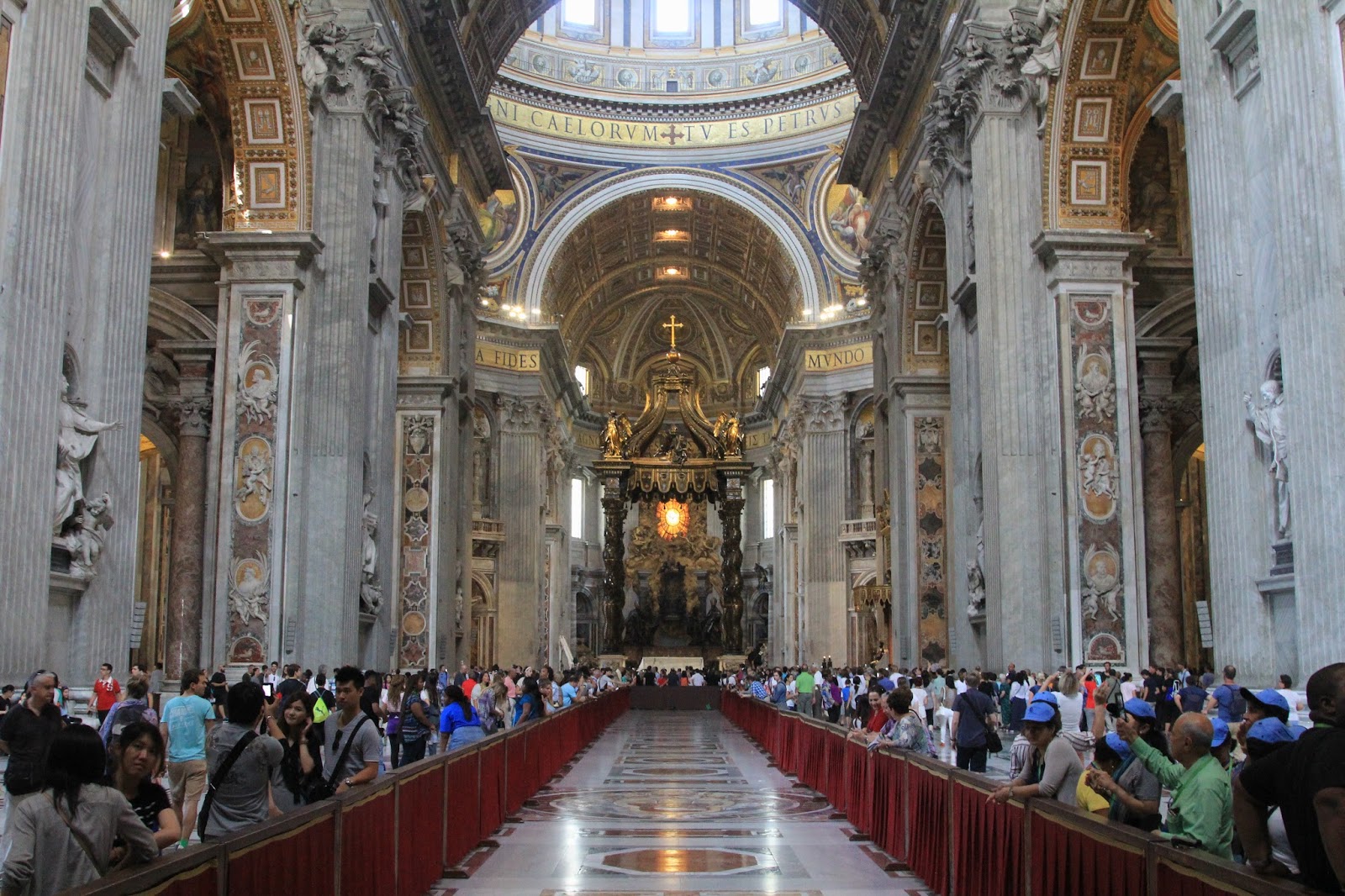
Inside St. Peter's Basilica
After the Sistine Chapel it was out through a side door and into St. Peter's Basilica -- the largest cathedral in the world.  It took 120 years to complete and was completed in 1626.  Michelangelo himself designed the dome that sits atop the cathedral although he did not live to see its completion.  Dripping with Baroque ornamentation, there's gold leaf everywhere.  One of the most impressive things for me is that there are no actual paintings in the cathedral.  Everything that looks like a painting is actually a mosaic -- tiny pieces of individually placed tiles.  Unless you inspect it very carefully and up close, you'd swear it was a painting.

Another interesting item you see when visiting is that there are markings on the floor indicating the length of other world cathedrals to put into perspective the relative size of those cathedrals to St. Peter's.  The closest in size is St. Paul's Cathedral in London, and it still has a ways to go to match St. Peter's.

Our three hour tour with Barbara went by way too fast.  There's no way we'd achieve the level of appreciation we gained if we'd have done the tour on our own.  Given the throngs of people walking through - you're literally shoulder to shoulder -- we'd have been hard pressed to sort out what we should see versus what was skippable.  If you go to see the Vatican -- splurge for the guide.  It's money well spent.
Tuesday, June 23, 2015

San Pietro in Vincoli

Just down the street from our hotel is San Pietro in Vincoli church.  Walking down the main avenue -- Via Cavour -- we walked up a steep flight of stairs into a square where the church sits.  Fairly nondescript from the outside, San Pietro in Vincoli -- translation St. Peter in Chains -- is an historic Roman church first built in AD 440 to house the chains that held Peter.

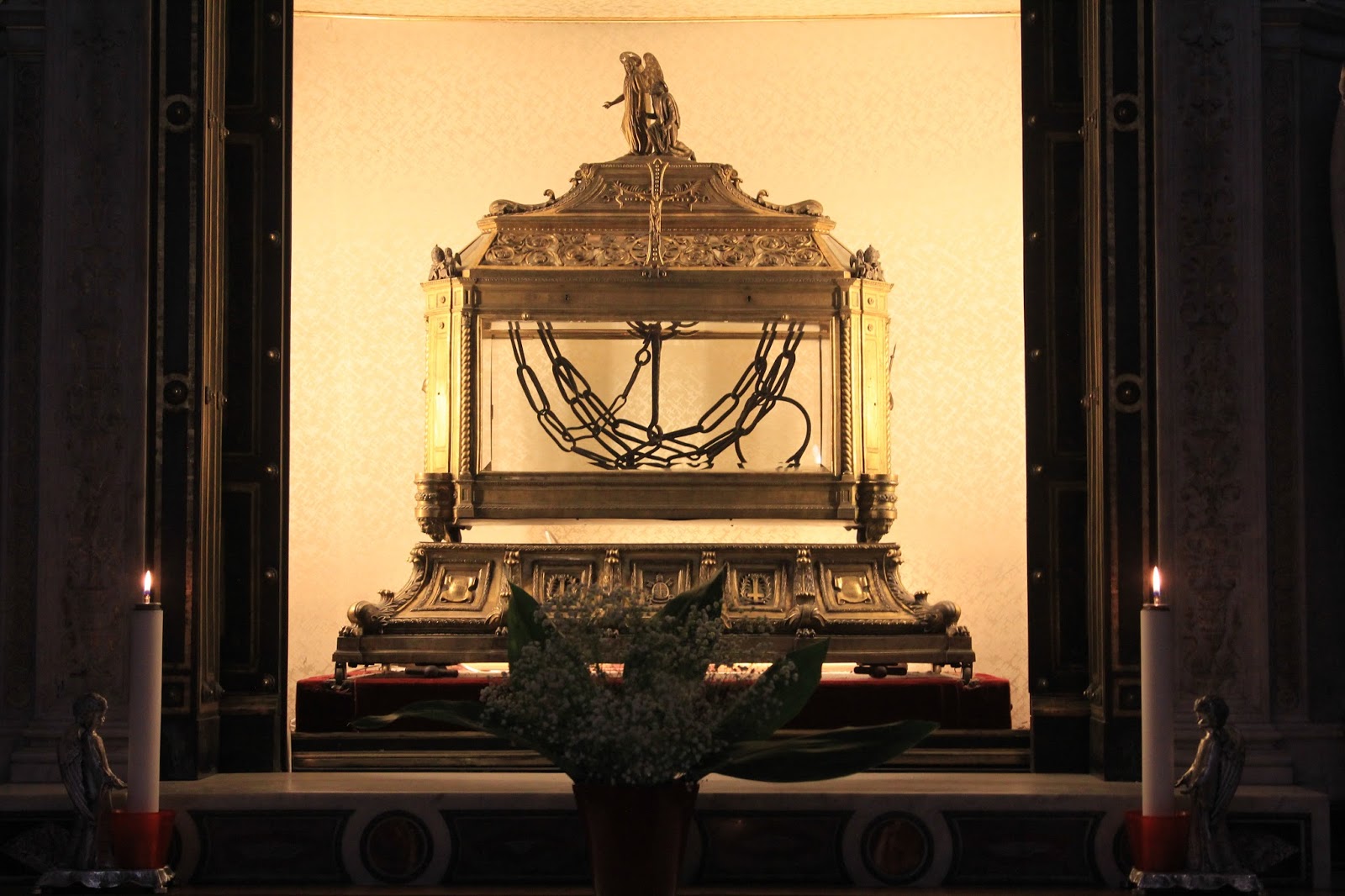
Peter's Chains behind the altar
Actually, there are two sets of chains -- one set used to hold Peter when he and Paul were held in the Mamertine prison in Rome.  The others were used in Jerusalem when Peter was jailed by Herod.  The chains from Jerusalem were a gift to the emperor in the waning days of the Roman empire.  According to tradition, when the two sets of chains were placed together, they miraculously joined into one.  The chains are displayed in a special case at the altar.

Moses
The church underwent significant changes around 1475, but the 20 Doric columns flanking either side of the church are original.  The other interesting item for which this church is noted is for is a statue of Moses by Michelangelo.  This statue was originally supposed to be part of a monumental work for the planned tomb of Pope Julius II in St. Peter's Basilica.  The pope would abandon this project and instead have Michelangelo paint the ceiling of the Sistine Chapel.

So many of he churches here in Rome have priceless works of art such as this Michelangelo statue.  They're free to see and usually not very crowded.  While you wouldn't necessarily say this church is off the beaten path, one of our favorite things about traveling is discovering these often bypassed sites.  You just have to know where to look.

Roman Forum and Palatine Hill

Arch of Titus
Our tour of the Colosseum with Barbara also included a guided tour of the Roman Forum.  The Roman Forum was the political, religious, and commercial center of the city.  It was the market, it was where returning war heroes had their parades, and it was the place of important political speeches -- you just had to imagine as Barbara would tell us.  This is an area of ruins, but one that archaeologists have examined for many years, and what still remains shows the impressive abilities of the Roman Empire to construct huge and elaborate buildings.  While they had indentured servitude and slavery to help them, it still would not have been possible without the architectural and engineering knowledge developed at the time.  What
View of Roman Forum from Palatine Hill
remains today is just a shell of its former glory, but Barbara showed us pictures of what the archaeologists have pieced together that the Forum likely looked like in its time and it would have been incredible.

Mona and I also walked up Palatine Hill while Mom and Pop took a break from all the walking.  There's more ruins to explore but we went for the view -- one fit for an emperor as he took in the grand expanse of the Forum from his palace that once stood here.

Monday, June 22, 2015

Colosseum

As we were planning this trip and thinking about what we wanted to do, Mona decided she really wanted to have a guided tour of certain sites in order to gain better knowledge and really appreciate the history of what we were seeing.  She definitely wanted a guided tour of the Vatican.  She researched different guides and groups on line and found a company called Tours of the Vatican that had a tremendous number of positive reviews.  One of the reviewers said they enjoyed their guided tour so much, they wish they had done one for the Colosseum as well.  I believe that was the deciding factor, and Mona said we had to use this group for tours of both sites.

Our first full day in Rome began with a guided tour of the Colosseum.  We took the Metro -- Rome's subway system is called the Metropolitan -- and met out tour guide Barbara outside of the Colosseum Metro station.  Barbara studied art history at university and really enjoys giving tours.  She was extremely knowledgeable of the history of the Colosseum and shared so much information.  I won't bore you by sharing everything we learned, but it is interesting how the Colosseum got its name -- Colosseo in Italian.

Originally, this was known as the Amphitheatrum Flavium - or Flavian Amphitheater.  This was due to being constructed by two emperors of the Flavian dynasty -- Vespasian and Titus -- between 72 and 80 AD.  These were the first two emperors after Nero.  There was a gigantic bronze statue of Nero nearby -- a Colossus -- or colossal in today's English.  So it began to be referred to as Colosseo by the Romans even though it served as a "theatrical" venue with gladiator fights, executions, and the like taking place in its heyday.  Even though this was considered an "amphitheater" in its day (which is a word we still use today), Colosseum stuck and the term is still used throughout the English-speaking world to refer to sports arenas.

Inside the Colosseum 
For me, the other most interesting tidbit was that the Colosseum could hold 50,000 to 80,000 spectators back in the day and could be completely emptied in 15 minutes.  Very efficient design by the ancient Romans.  Now if only we could figure how to do that after our own sporting events in the 10,000 seat arena instead of spending a lot longer trying to get out.

Sunday, June 21, 2015

Aqueduct Park

It's hard to do much on the day you arrive given the lack of sleep on the plane and trying to ward off jet lag.  We have some longer tours and lots of walking the rest of the week so we thought the best course of action was not to do a whole lot and just get our bearings.  After buying the Roma pass, we went ahead an activated it so we could start riding the subway.  There's only 2 lines currently -- A and B -- that sort of form an X as they crisscross the City.

We decided to visit Aqueduct Park (Parco degli Acquedotti).  This is a natural park area near the south end of the A line at the end of Viale Giulio Agricola.  This is a popular spot with locals to bike and picnic.  It's well off the traditional tourist path and it certainly seemed like we were the only non-locals there.  There we found the best preserved sections of aqueducts that date to the Roman empire. The Acqua Claudia pictured here dates to the first century A.D.

As we walked closer to the ruins to get a better view, it seemed like we were the only ones there.  The  park is left to its natural state -- no manicured lawns or mowed areas around here.  In fact, it seemed like one section of the remaining aqueduct was standing in a field of wheat.  It's hard to think back on the ingenuity and ability of the Romans to build such a massive structure that transported water from the mountains into Rome.  This ruin was also in the flight pattern of nearby Ciampino Airport so it was interesting juxtaposition to see a 2000 year old aqueduct standing tall as a 20 year old passenger plane flew right over it.

This was a great start to our trip -- seeing two millennia of history but without all of the crowds.  Those are coming tomorrow as we tour the Colosseum.  

Buongiorno da Roma

Good Morning from Rome!  After our overnight flight from the US, we landed about 9:40am local time.  After getting our passport stamped and collecting our luggage, we met our driver who drove us directly to our home for the next five nights -- Hotel Raffaello.  We drove right past the Colosseum, Palatine Hill, and the Roman Forum -- only an hour into our visit and we're seeing thousands of years of history.

Italy is known for its HOT summers.  The weather forecast for the next few days looks very promising -- highs in the low 80s and down in the 60s at night.  The high today is right at 80.  Let's hope the good fortune continues.

Our first order of business is purchasing our Roma Pass which allows us free entry to our first two sites as well as unlimited use of the subway and buses.  Off to explore!

Sunday, January 4, 2015

Wesley's Chapel and John Wesley House

Wesley's Chapel
John Wesley along with his brother Charles were the leaders of the Methodist movement in the late 1700s that gave rise to the formation of the Methodist church.  Anyone who's grown up in the Methodist church, as we have, knows the Wesley name.  Along City Road in London is Wesley's Chapel, the church he built in London in the late 1770s along with a Georgian-style house that Wesley spent his final years until his death in 1791.  This house continued to serve as the parsonage for the minister of this church until a new one was built on the grounds in the late 1800s.

Wesley's Chapel remains an active congregation of the Methodist Church with services every Sunday.  In the crypt of the church is the Museum of Methodism outlining Methodist history, with a lot of Wesley artifacts including the pulpit he preached from prior to the opening of Wesley's Chapel.  Margaret Thatcher was married in this church and both of her children were baptized here.  In 1993, she donated the communion rail that is still in use today.