Saturday, July 10, 2021

Olympic Fever


The Summer Olympics in Tokyo will be held later this month and Seward's own Lydia Jacoby, a 17 year-old swimmer will be a part of the team.  She's the first swimmer from Alaska to make the Olympic team.  We've seen these signs all over town.  To say they're proud would be a gross understatement.  She had the second-fastest time in the world this year in the 100-meter breaststroke meaning she'll be in the hunt for a medal.  Probably a good reason she missed yesterday's Mt. Marathon Race after having participated the last four years.  We'll be cheering for her too.

Thursday, July 8, 2021

Mt. Marathon "Marathon"

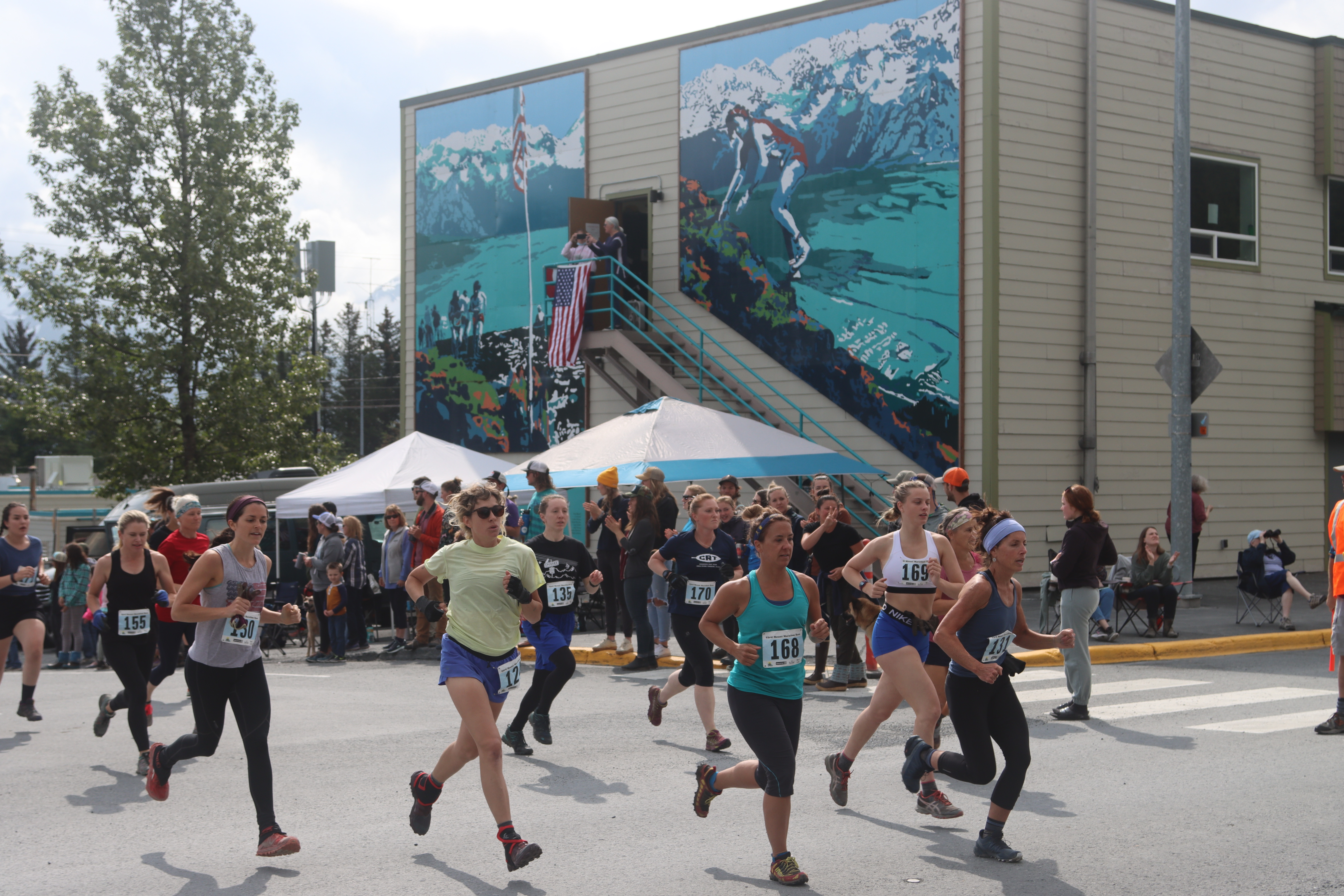
Mt. Marathon is one of several mountains that surround Seward.  There's a trail up to the summit which starts right from downtown.  Every year on the 4th of July there's a race to the top of Mt. Marathon and back down.  It's not actually a marathon, but it's slightly longer than a 5K.  Runners from around Alaska and across the United States vie for one of the limited spots in the race each year.  This year was the 93rd running of the race, and because of the ongoing pandemic, the race was moved to July 7th in the middle of the week to limit the crowd size.  That's fortuitous for us as we had no idea the race would be taking place since we weren't here on the 4th.

Why is there such a race in the first place?  From the race website:

According to folklore....the tradition of the Mount Marathon Race began when two sourdoughs argued about the possibility of climbing and descending the mountain in less than an hour.  "Impossible" one said.  To settle the argument, and the resulting wager, a race was held, with the loser to furnish drinks to the crowd.  Enterprising merchants put up a suit of clothes and other attractions for the winner and proposed the race take place on a holiday - why not the 4th of July?  The optimistic sourdough lost his bet.  The winning racer took one hour and two minutes.

**A sourdough is the term used to refer to an Alaskan who has lived here "for several winters," i.e., a long time

So essentially the race is the result of a bar bet.  This is small town Americana at its best.  The whole town comes out to cheer the racers on, and it's now celebrated as a multi-day festival.  The all-time record winning time for men is 41:26 and for women is 47:48.  Basically about 30-35 minutes up the mountain (3,022 foot elevation) and about 10-12 minutes down.

After watching runners slip on the mountain and come down covered in mud from falls, I'll stick to being a spectator.


Wednesday, July 7, 2021

Exit Glacier and the Harding Icefield Trail

After our Denali adventures and a night spent in Anchorage, we've headed south to the Kenai Peninsula.  We've now landed in Seward for three nights.  Top of our list of things to do while we're here is visit Kenai Fjords National Park and hike the Harding Icefield Trail.

Kenai Fjords National Park has over 40 glaciers all fed from the Harding Icefield.  The Icefield is over 1,100 square miles and caps the Kenai Mountains.  Exit Glacier is the most accessible of the glaciers as you can drive out to the visitor center and walk a mile to the observation area near its toe.  Alas, the glaciers are receding at a fairly fast pace.  There are signs as you drive in showing you various years that mark how far out the glacier used to come from the Icefield.   It's quite sobering to drive and walk past these signs and realize the receding of Exit Glacier can be measured in miles.

Seward and this portion of the Kenai Peninsula are considered to be a temperate rainforest climate.  It's quite the juxtaposition of seeing a glacier next to dense, tropical-style vegetation as you walk out to the glacier and hike the trails.  

The Harding Icefield trail is a four mile one-way trail (eight miles round trip) that gains about 3,300 feet in elevation as you go up the trail.  There are basically three lookout points -- Marmot Meadows, Top of the Cliffs, and End of the Trail.  We decided to stop at Top of the Cliffs, mainly because the trail above that area still had lots of ice and snow and we could see folks slipping and sliding trying to navigate that portion of the trail.  While we missed seeing the vast expanse of the Icefield itself, we were still treated to incredible views of the glacier and the edge of the Icefield.  The trail goes though a lush, dense forested area, across a cascading waterfall, before you begin the steep ascent.  You then enter an area of ground brush before climbing into the tundra and minimal vegetation.

The ice appears Blue
With a guide and the proper permits, you can actually hike on the glacier itself.  We did a glacier hike many years ago in our 30s and now that we're not in our 30s, we thought we'd just stick with the traditional hike.  We loved the combination of hiking through the forest before opening up to cliffs overlooking the glacier.  It rains a lot in Seward, but we were fortunate to have no rain and an overcast morning only to be greeted with full sun and clearing skies in the afternoon.  Sections of the ice appeared blue and when the sun came out, it really made the glacier sparkle.

Hikers out on the glacier

No wildlife sightings on this hike, but the views were breathtaking.  Our legs will be sore tomorrow but I'm not complaining.  Another fabulous Alaskan day.

Tuesday, July 6, 2021

The Bus Ride Didn't Disappoint

Grizzly Bears
Our 90-mile bus ride from Kantishna back to the Visitor's Center did not disappoint.  Besides more great weather and being able to see Denali, we saw lots of wildlife including grizzly bears, caribou, and dall sheep.  


A fantastic finish to our Denali adventure.


A Herd of Caribou


Dall Sheep high up the mountain


Saturday, July 3, 2021

Into the Wild

Staying at the lodge in Kantishna gives us the best of both worlds — we’re deep inside the park surrounded by nature and very few people, but we also have a bed, shower, and three meals a day.  Apologies to everyone who loves to camp, but that is not in my DNA.  Love to be outside and hike all day, but I want a comfy bed to sleep in.


Skyline Lodge has mountain bikes to use so our first adventure was to ride about five miles over to Wonder Lake.  There’s a single 92 mile-long gravel road inside the park that stretches from the park entrance all the way to Kantishna.  Private vehicles aren’t allowed — only Park Service Buses use the road — so no worries about traffic.  We were the only ones out on the road which made it seem like we had the entire park to ourselves.  It also helped that we’re still adjusting to Alaska time and we were out at 5:00am.


When conditions are right, Wonder Lake provides a beautiful reflection of Denali and the entire Alaskan Range.  On average, Denali is only visible one every three days.  Because it’s over 20,000 feet, it is frequently shrouded in clouds and can create its own weather patterns.  We’ve been blessed with fantastic weather and Denali has been clearly visible two days in a row.  We were treated to fantastic views of the mountain almost the entire bike ride.  Although the water was not perfectly still, we were able to capture fantastic reflections in Wonder Lake.


Even though we were traveling a fairly well-used road, we saw many reminders that we are out in the wilderness.  We passed fresh bear tracks and random piles of scat.  Even though a bear encounter is unlikely, it does happen and you need to carry bear spray with you at all times. 


Later we did a four-mile hike up to Quigley Ridge.  It is super steep from the outset, gaining 1,200 feet in less than a mile and was probably one of the steepest trails we’ve done.  At the top we were treated to 360 degree views.  We could make out Denali in the distance, but clouds had moved in making it difficult to discern what was mountain and what was clouds.  As we hiked back down, there were lots of bushes and we encountered a male caribou.  He was maybe 10 yards away and was so engrossed with his eating that he didn’t pay any attention to us.  At times all we could see were his antlers as he chomped away at berries and vegetation.


Our time in Denali has rapidly come to a close, but I couldn’t ask for a better experience.  The weather has been great and we’ve been treated to incredible views and scenery.  In the morning, we take the bus back out to the entrance to continue our Alaskan journey.  Wildlife sightings are common on the bus ride, so here’s hoping our good fortune continues and we’re treated to a full day of final Denali experiences.

Denali Flight Seeing

Our introduction to Denali National Park involved a very small plane and a “flight seeing” adventure.  We wanted to stay inside the park, and Denali doesn’t have the typical lodges like you might find at Yellowstone or Glacier.  Most of the lodging is outside the park.  However, there is an area 90 miles deep inside the park called Kantishna.


Kantishna was an old mining area before the national park existed and there are four private lodging facilities.  There is no electricity (except what the lodges generate themselves) and no cell coverage.    Truly a time to be off the grid.


We’re staying at Skyline Lodge which is the base of operations for Kantishna Air Taxi, hence the flight seeing adventure.  Typically, to stay at one of these lodges you ride a bus for several hours from the entrance.  With Kantishna, they offer the ability to fly in because there is an airstrip near the lodges where they fly in and out.  And by airstrip, I mean a long strip of gravel.


The weather was absolutely perfect.  Bright blue skies and very few clouds.  Denali is a vast park and seeing it from the air was incredible, but without a doubt the highlight was getting up close and seeing Denali Mountain.  The tallest peak in North America at over 20,000 feet, it was called Mount McKinley for decades before returning to its original native name.  Spectacular probably isn’t a good enough description.  It was truly awe-inspiring to see.  I took way too many pictures, but I think this one is my favorite:


Friday, July 2, 2021

Land of the Midnight Sun

One of Alaska’s nicknames (at least in summertime) is land of the midnight sun.  They aren’t kidding.  The sun is still shining at midnight.  We’re less than two weeks after the summer solstice which has the longest daylight of the year.  Here in Alaska, it’s about 19-20 hours of daylight.  Our flight into Anchorage landed at 10:15pm and you would have thought it was still middle of the afternoon given how much daylight there was.  Luckily for us, we have blackout curtains.  We’re going to need them.