Saturday, July 21, 2018

Vermont Detour

After leaving Fort Ticonderoga, we started our drive up to Lake Placid, but not before taking a brief detour into Vermont.  One of Mona's coworkers has family in the Crown Point area north of Ticonderoga and said they would always drive over the bridge into Vermont for some ice cream.  Home to Ben & Jerry's, Vermont is certainly known for good ice cream.

Our detour took us over Lake Champlain to the Bridge Restaurant.  Packed with people at 2:00pm, we were able to take one of the last two tables for lunch.  They didn't have the choices that Martha's did, only vanilla, chocolate, and a vanilla-chocolate swirl.  We opted for one cone of the swirl to share and our waitress showed up to our table with three ice cream cones -- one vanilla, one chocolate, and one that had the tiniest bit of swirl.  Apparently the machine wasn't working correctly, so she brought us some of both.  We certainly weren't going to let good ice cream go to waste, so of course we ate it all.  It was very good, but it was no Martha's.  No need for dinner tonight.

We could see a lighthouse from our vantage point in Vermont, so once we crossed back into New York, we stopped and visited.  The Samuel Champlain Memorial and Lighthouse was built by both New York and Vermont in 1909 to commemorate his discovery of the lake in 1609 that bears his name.

Cool bridge -- Great Food -- Historic Lighthouse.  All in all, well worth the detour.

Fort Ticonderoga


Fort Ticonderoga and Lake Champlain, seen
from atop Mount Defiance
After saying goodbye to our new friends at Romeo & Giulietta's, we drove to the north end of Lake George to visit Fort Ticonderoga. Another important fort in our country's early history, it was the site of a British victory immediately before their defeat and surrender at Saratoga.  Originally built by the French and called Fort Carillon, it was renamed Ticonderoga after France's defeat in the French and Indian War.  The fort was strategically located between Lake Champlain and Lake George, along the border of present day New York and Vermont, and was a key outpost in the the early development of the United States.

As with other historic sites on this trip, you would assume it is a part of the National Park Service; however, it is privately owned and maintained by a non-profit.  The earliest act of preservation of this fort was undertaken by the Pell Family in the 1820s.  Less than a century later, the non-profit museum was created and the fort restored making it one of the earliest preservation efforts in the history of the United States.

Lake George

Southern end of Lake George
This is our first trip to upstate New York and we know several people who highly recommend Lake George, including a couple of folks whose families come every year.  The Village of Lake George is at the southern end of the lake.  While the main drag through town is tourist central with lots of motels, gift shops and tchotchkes for sale, it only takes a block or two to get into the residential neighborhood where it is much quieter and where you'll find most of the locals.  We found a great B&B -- Romeo & Giulietta's Hideaway -- located about 3 blocks off the main drag and a 3 minute walk to the lake.  This was our base for three nights in Lake George.

Summit of Sleeping Beauty Mountain
After the rainy day down in Albany, the weather broke and we enjoyed temps in the 70s with no humidity.  My kind of summer weather!  We hiked to the summit of Sleeping Beauty Mountain and were treated to gorgeous views of Lake George and the surrounding valleys.  Although there were plenty of opportunities to take a boat cruise in the lake, we opted for hiking and enjoying the Town.

Our B&B hosts recommended Martha's for THE best ice cream and it did not disappoint.  We had to drive there as it was located about 3 miles south of town, but the ice cream was heavenly!  We loved it so much, we had to go back a second time.  I'm holding a large cone of Orange Creamsicle -- the best $4.40 I've ever spent for ice cream.  After that experience, we'll be making a detour whenever we're within 50 miles.

Rainy Day Trippin'


Saratoga Battlefield overlooking the Hudson River
Unfortunately, our first day in Lake George was overcast and rainy so we decided that would be the best day to head down to Albany and check out New York's capital.  On the way down, we caught another national park site, Saratoga National Historical Park.  The Battle at Saratoga was very early in the Revolutionary War, but may have been the turning point to American victory as it was the first time the mighty British Army had ever surrendered.  While there had been previous defeats, the British had always retreated in those instances.  Their surrender at Saratoga gave the Americans legitimacy and caused the French to join the American cause culminating in the ultimate British defeat at Yorktown.

New York Capitol
This trip provided another chance to complete our lifelong quest to visit all 50 states and 50 state capitals.  While we've been to well over half of the states, we haven't yet visited all of the capitals in those states.  Albany marks the turning point, as we're now more than halfway towards our goal of all 50 state capitals and capitol buildings.

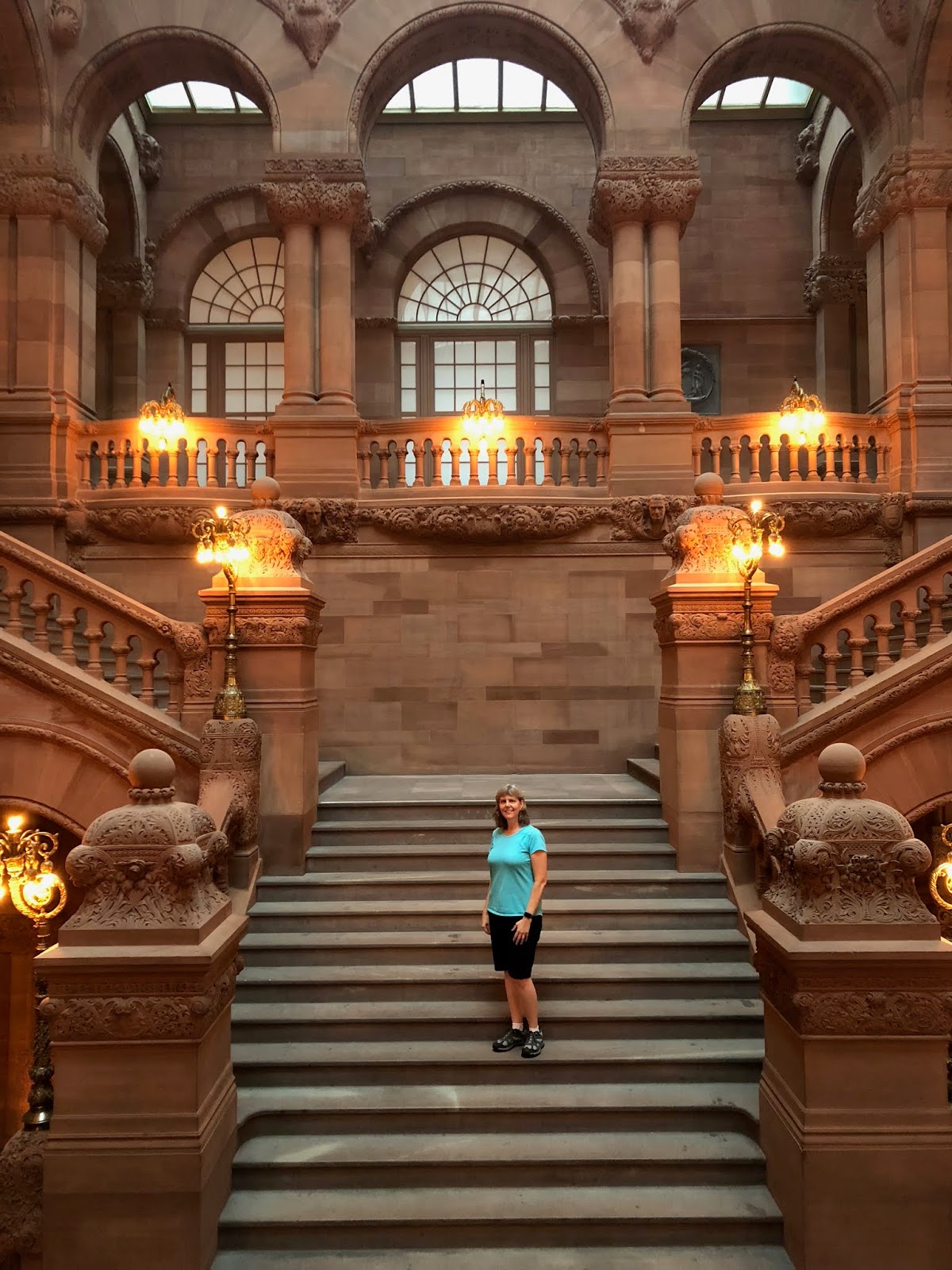
The New York State Capitol is a gorgeous building that is not the quintessential capitol
The Great Western Staircase
with massive columns and a rotunda.  It was completed in 1899 and is on the National Register of Historic Places.  it has three massive staircases in the building, each with it's own different architectural flair.  Unlike our visit in Nevada, we didn't run into the governor this time.  In one way, the gorgeous architecture of this building is wasted as the surrounding square and other government buildings are very drab and utilitarian.  Given the history of the nation and the important role New York played, especially in the early days, one would think a more complementary, cohesive style or architecture would grace such an important area.

We concluded our time in Albany with a visit to the Stephen and Harriet Myers House.  You likely won't read about this in many guidebooks, but the Myers and this home were an integral part of the Underground Railroad.  As the only ones there that day, we were treated to a personal tour and learned about the history of the Myers family and how they helped so many former slaves during that time period.  Unlike visiting other historic sites, this is clearly a work in progress.  The house still needs a tremendous amount of restoration work on the interior, but the small non-profit that owns and operates the house are working diligently to raise the funds needed to make this a reality.  This is an important story to tell and history to preserve, so I certainly hope they are successful.

Friday, July 20, 2018

Four Sites in One Day


Springwood -- FDR's Home
After leaving New Jersey, we drove up to Lake George, New York, through the Hudson River Valley. This is home to five National Park Historic Sites and we were able to stop and visit four of the five.  Thomas Cole NHS was the fifth and we drove right past it on our drive and would have made it five for five, except it's closed on Mondays.

Val-Kill


First stop was Hyde Park and the Franklin D. Roosevelt NHS and Presidential Library.  The library is a private entity separate from the National Park Service and we decided to forego that and just tour his historic home and property.  Also in Hyde Park is the Eleanor Roosevelt NHS, the family's summer cottage known as Val-Kill.  Eleanor made this her permanent home after FDR's death.

Vanderbilt Mansion


Just down the road from FDR, was the Vanderbilt Mansion, a massive home and grounds with commanding views of the Hudson River.  Situated on a bluff high above the river, we were able to drive down to the water and dip our toes.

Lindenwald


Our last visit was to the Martin Van Buren NHS, the former president's home called Lindenwald.  We were able to get there right before closing, and although we didn't tour the home, we were able to walk the grounds and learn about its history.  We had the entire place to ourselves.


It's always fascinating and interesting to learn about the history and back stories of these important figures in American history.  We heard great stories such as King George VI visiting FDR at his home, and how many important political figures would drop by Van Buren's house because it was on the main post road between Albany and New York City.  In fact, a portion of the old post road still exists on the Van Buren property.

The National Park Service does a wonderful job preserving our historic sites and properties, and we always come away learning so much that we never covered in school.

Thomas Edison House and Museum


We started our Summer 2018 Road Trip with a weekend visit to New Jersey to see family.  My cousin recently had her second child and this was our first time seeing the baby.  We had a great time visiting, playing with the kids, and eating a lot of my aunt's great Italian cooking.  I think I gained 10 pounds in just one weekend.

Our lone adventure was a visit to the Thomas Edison National Historic Site in West Orange, which houses Edison's laboratory complex and
Edison's Laboratory Complex
the family home Glenmont.  We learned about Edison inventing the light bulb and the phonograph in school, but he and his team were constantly developing new things.  So much of what we enjoy today such as cell phones, video and movies are built on the foundation of Edison and his team.

The story behind the family home is equally as fascinating.  Located in Llewellyn Park, one of the first planned communities in the United States (and currently a gated community of very expensive homes), the house was originally built by Henry Pedder in 1882 at a cost of about $250,000.  As it turned out, Pedder was embezzling the money from his employer in New York City.

Glenmont
Rather than be prosecuted, he turned over the house to the company and Edison was able to buy it for a mere $125,000.  The house was built with many modern amenities for its day, including separate hot and cold running water, and Edison wired it for electricity in 1887.  Even by today's standards, the house would be a lovely place to live and raise a family, but I certainly couldn't afford it.


Saturday, March 31, 2018

Final Greece Thoughts

Unfortunately, our time in Greece has come to a close. This has been a fantastic trip with great weather, beautiful ancient sites and history, and warm and welcoming people.  A few final odds and ends:

  • Gyro and souvlaki pitas are fantastic!  Every meal has been great, but I will miss these the most.  I think we ate one every day.
  • The plumbing is not so great.  You don't put toilet paper in the toilet, but in the wastebasket next to the toilet.  Our understanding is because the pipes are small and clog easily.  We experienced this same issue when we traveled to Russia.  Not a big deal, but we had to keep reminding ourselves as not every bathroom had a sign.
  • The Greeks are very proud of their country.  We were warmly welcomed and everyone seemed happy to provide assistance.
  • It was amazing to walk the same sites and experience 3,000 years of history first hand.  While we read about Ancient Greece in school, being able to experience it in person was breathtaking.
  • Driving in Greece is an offensive sport.  Stop signs (when there are any) are merely a suggestion as are speed limits.
  • We need to plan a return trip.