Saturday, March 31, 2018

Ancient Corinth

Temple of Apollo
The last stop on our Ancient History tour was to ancient Corinth.  Those of the Christian faith will recognize this as a place where the Apostle Paul traveled to preach and convert people to Christianity.  Paul lived here over a year and his letters to the Corinthians are some of the most quoted verses from the Bible.

Unlike Epidavros and Mycenae, Corinth was not nearly as crowded with tourists.  While there was a bus in the parking lot, it felt as though we had the place to ourselves.  We probably should have researched a little more before we went as the ancient site wasn't well marked and there weren't any brochures or literature to guide us.  Even so, it still felt remarkable to walk in the footsteps of Paul.

Pop standing in the Bema where Paul was on trial
We did learn that Paul was a tent maker and lived with a couple who were also tent makers.  When he wasn't preaching, he was working in the market alongside everyday Corinthians repairing awnings and such.  Paul was arrested and put on trial for his preachings, but the Roman governor viewed this as a local dispute between Jews and Paul was released.  After leaving Corinth, Paul continued on to Ephesus.  We were able to see the ruins of the Hema, the building where Paul would have been on trial, and perhaps stand in the very spot he did.

It was an interesting juxtaposition to see the Temple of Apollo and realize that this was still in existence and actively used while Paul was in Corinth.  The idea of worshipping Jesus versus Apollo or Athena had to be jarring to the 
Corinthians, yet Paul planted a seed and was able to establish a church here.

Corinth Canal
After leaving ancient Corinth, we made a brief stop at the Corinth Canal.  The canal itself was constructed in the late 1880s so it's not particularly ancient, but the idea of such a canal can be traced as far back as the 7th century B.C.   The canal connects the Gulf of Corinth with the Saronic Gulf in the Aegean Sea and saves a 450 mile journey around the Peloponnese.  However, it's only 70 feet wide and 26 feet deep so most modern ships cannot use it relegating most of the journeys through to tourist boats.  Still, it's an impressive feat to have carved out this canal through the rock.

Friday, March 30, 2018

Mycenae

Lion Gate c. 1300 B.C.
After Epidavros, the other major excursion while we stayed in Nafplio was to the ancient ruins of Mycenae.  Mycenae was a fortress city atop a hill and the capital of multiple city-states through the region.  Dating back to 1600 B.C., the Mycenaeans ruled this area for about 500 years.  Their civilization predates the Acropolis in Athens by a thousand years.

The Lion Gate and all that you pass through to enter the ancient city dates back to circa 1300 B.C.  Although not a sophisticated nor as structurally strong as the Roman arches developed later, this massive entrance has stood for over three thousand years.  

Just down the hill from the fortress is the Treasury of Atreus, a massive beehive-shaped burial chamber built into the side of the hill.  Mycenaean kings were buried in these structures along with swords, jewelry, etc., in similar
Entrance to Treasury of Atreus
fashion to the ancient pharaohs of Egypt.  Ironically, the beehive shape of the structure must have called out to actual bees because there were many swarming around the entrance and inside.  The buzzing echoed throughout the massive chamber and I was just as content to get a quick glimpse inside and then wait for everyone else outside.

Thursday, March 29, 2018

Nafplio

Bourtzi Fortress
Nafplio has been a great base from which to explore the Peloponnese.  There's Old Town Nafplio which borders the harbor and then the newer sections of town that spread back out towards the surrounding mountains.  We're staying at the Pension Marianna in the Old Town section.

Because of it's strategic importance through the years, Nafplio has three different fortresses.
Akronafplia Fortress (taken from Palamidi
fortress above)
The Bourtzi fortress sits offshore and guards the harbor.  The Akronafplia is atop the Old Town section of the City and is the oldest of the three fortresses.  The Palamidi fortress was built by the Venetians in the early 1700s and sits on a hill above the Akronafplia.  Our hotel sits adjacent to the Akronafplia fortress -- in fact, we walk through a part of the outer wall in order to access our hotel.

Palamidi Fortress
The town itself exudes a certain charm and we're enjoying soaking it up and strolling the narrow lanes and along the waterfront.  We've already been to Epidavros and we'll also be visiting the ancient archaeological site of Mycenae.  This has been a very relaxing stop as we begin to wind down the second half of our trip.


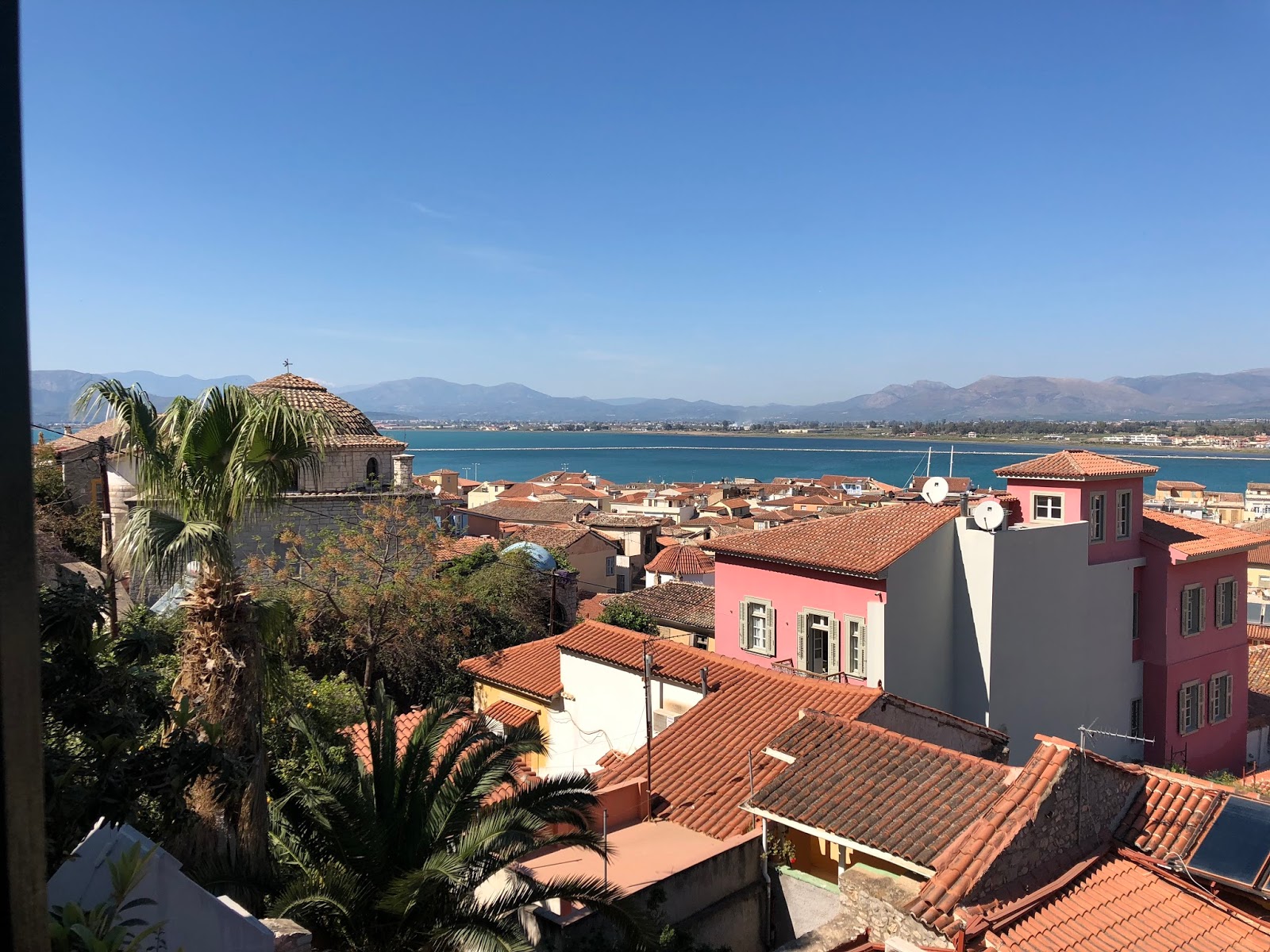
Looking out the window of our hotel room

The view from our room

The Early Bird Gets the Worm!!


The theater from ground level
We've left Olympia and are now in the town of Nafplio, a seaport town on the Argolic Gulf which is part of the Aegean Sea.   This will be our base for the next two days.  Our first excursion was to the ancient site of Epidavros, which is famed for its acoustically marvelous amphitheater.

We were out the door at 7:15am for the 30 minute drive to Epidavros in order to be there when they opened at 8:00am.  I wanted to be there with as few people as possible in order to experience the famed acoustics.  Our efforts paid off as not only were we the first people through the gates, we were the only ones there for the first 30 minutes.

View from the top row
The theater was built circa 300 B.C. and can seat up to 15,000 people.  During the summer months, it is still used for outdoor theater productions, but we're here too early in the year to catch a play.  What we could do though is test the acoustics, and it was a remarkable experience.  You can stand in the middle of the "stage" area (really just a circle that is surrounded by the first row of seats) and speak in a normal voice.  Even those sitting in the last row at the top of the theater can hear you as if you were sitting right next to them.  We took a brief video with our phone, and while it's not as good as being there in person, it gives you a good idea of how great the acoustics are.


By 8:30am, the first of three tour buses pulled in with gaggles of tourists.  While I hope they could experience the marvelous acoustics as we did, I can't imagine they did because it became too noisy too fast.  Getting up early definitely paid off as they could not have had nearly the appreciation that we did.


Tuesday, March 27, 2018

Ancient Olympia

Altar and Temple of Hera
We experienced a taste of the modern Olympics in Athens when we visited the Panathenaic Stadium.  Today, we visited Ancient Olympia where the Olympics were first held circa 776 B.C. and continued for over a thousand years to 393 A.D.  These quadrennial athletic contests were held to honor and worship Zeus, king of the gods.

Ancient Stadium
Our journey to Olympia took us through the mountains and along the Gulf of Corinth, traveling over the gulf across the modern bridge built just a decade ago.  We stopped briefly along the way in a small town whose English name is Lemon Canyon so Mom could touch the water and collect a rock to take home.

On the starting line
Olympia is located on the large peninsula of Greece known as the Peloponnese. We toured the archaeological site and saw the ruins of the Temple of Zeus and the gymnasium where the athletes trained.  Our two favorite parts of the site were the stadium, where the original marble starting and finish lines still adorn the track, and the Temple and Altar of Hera, where the flame is lit each Olympic year to travel to Athens and then on to the host country.

Temple of Zeus
Lots of families, young and old, took their place on the starting line and sprinted the length of the stadium.  Although we didn't witness any Olympic-caliber times, it was still amazing to to be able to run sprints in the same place as thousands of athletes have for three millennia.

Delphi

Temple of Apollo seen from the amphitheater above
On Monday morning we bid adieu to Athens after three wonderful days soaking up its history.  We left our apartment bright and early to travel back to the airport and pick up our rental car.  After experiencing Athens traffic and narrow streets, I'm glad we are picking up our car outside of the city.

I've dubbed this trip the Ancient History Tour as our itinerary is filled with visits to historical sites and ruins.  We won't have time to visit any of the islands.  We'll have to reserve that for a return trip.  After about 2 hours of driving, we've reached our first destination -- Delphi.

5th Century B.C. Stadium
Delphi was known throughout the world as the home of the Oracle of Delphi, a prophetess who was the mouthpiece of Apollo on earth.  Pilgrims would travel from all over to seek her advice.  During this period, Delphi was considered to be the center of the world and one of its sacred sites.  Our first stop was the archaeological site to walk the Sacred Way and see the Temple of Apollo.  Ancient Delphi was a place of worship centered on the Temple of Apollo.  The temple site is surrounded by the remains of grand monuments that were paid for and built by grateful pilgrims.

Charioteer circa 480 B.C.
The ancient site and the nearby modern town are located in the side of Mount Parnassus.  Seeing the site requires a nice uphill hike from the road.  For me, one of the most interesting aspects was the ancient stadium built in the 5th century B.C.  It's at the highest point of the site (up a very steep trail) and hosted the Pythian Games, second in importance only to the Olympics.  It's remarkably well preserved, so much so that it could probably host athletic competitions with a minimal amount of renovation.  Not bad for a 2,500 year-old stadium.  The archaeological
museum houses many of the original artifacts from the ancient site, many of which date back 2000 years or more.  Their prized possession with a room unto itself is a bronze charioteer circa 480 B.C.  It is believed that a great earthquake some 100 years later buried the statue in debris, helping to protect it from the elements.

Sanctuary of Athena Pronea -- Athena was also worshipped
at Delphi along with Apollo
The modern town of Delphi is defined by two narrow, parallel streets.  We spent the night here and our hotel provided great views of the valley, lined with groves of olive trees all the way to the Gulf of Corinth.  Delphi is a popular day trip, especially from Athens, so there were lots of tour buses when we arrived.  However, by about 3:00 pm, they were on their way back to the City and it felt like we had the town to ourselves.  Another great day soaking up history and enjoying the hospitality of our Greek hosts.

The view from our hotel balcony -- Hotel Fedriades


Monday, March 26, 2018

Final Day in Athens

Temple of Olympian Zeus
Our final afternoon in Athens was spent wandering the streets of the old Plaka and Anafiotika neighborhoods near the Acropolis and seeing some of the other historic monuments and ruins.  Because of the holiday, we couldn't walk the sites, but I was able to take pictures.  We also wandered the streets of the Monastiraki neighborhood including its several streets of flea market activity.  We grabbed a couple of souvlaki pitas at the take out window and ate while we strolled the narrow streets and alleyways.

Hadrian's Gate
At the end of the day, we climbed both Mars Hill and Filopappou Hill in order to get better views of the Acropolis.  Mars Hill is where the Apostle Paul preached to the masses in Athens centuries ago, but Filopappou Hill has the best view.  It was very windy while we were at the summit, but it we didn't mind as the view was priceless.


The View from Filapappou Hill