Sunday, March 31, 2013

Iceland. Hello.

Happy Easter!  We have arrived in Iceland and hit the ground running.  After touching down at 6:20 AM local time and catching a shuttle to our hotel, we caught a quick catnap before heading to Hallgrimskirkja (Hallgrimur's Church) for the 11:00 AM Easter service.  It's named for Icelandic poet and clergyman Hallgrimur Petursson.  Icelanders are mainly Lutheran and this is the largest and most iconic church in Reykjavik.

My Icelandic is a little rusty, but we were able to follow the service and the music was glorious.  Hallgrimskirkja has the largest pipe organ in Iceland with four manuals, 72 voices, and 5,275 pipes, and they certainly pulled out all the stops.  The choir had about 60 voices and were excellent, filling the cathedral with a very rich sound.  The service was heavy on music including Widor, Handel, Schutz, Handel, and the French composer Louis Vierne.

After the service, we went to the top of the bell tower and were treated to sweeping views of Reykjavik and the surrounding areas.  Even though we didn't necessarily understand the spoken word, the light of Christ was present and I couldn't think of a better way to start our Icelandic journey.  Hallelujah!  Christ is Risen!
Central Reykjavik and surrounding mountains as seen from the Hallgrimskirkja Bell Tower.

Monday, April 16, 2012

Den Haag

While Amsterdam is the official capital of the Netherlands, Den Haag (The Hague) is the seat of government.  It is here where the Dutch Parliament is located.  It is also where the United Nations has a large presence, including the International Court of Justice.  Den Haag is an easy day trip from Amsterdam -- it's less than an hour by train and it seems like every 10 or 15 minutes a train is leaving Central Station that stops there.
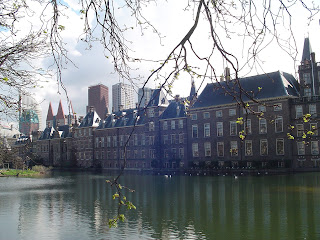
Dutch Parliament Complex
After we visited the Anne Frank House, we left late morning for our visit.  The region between Amsterdam and Den Haag is the major bulb growing area and we passed many fields in bloom along the way.  Our agenda included visiting the Dutch Parliament, the International Court of Justice, and the Mauritshuis Royal Picture Gallery where Vermeer's Girl with a Pearl Earring resides.  What we envisioned was going to be at least a half-day visit turned in to something much less.  The Mauritshuis closed on April 2 for renovations, but we didn't find that out until we showed up at the front door looking to get in.  Fortunately for us, they moved the Vermeer to another gallery down the street -- The Prince William V Gallery.

The Prince William V Gallery is only one room (sweet!!), so it made for a very quick visit.  We took a tram to see the International Court of Justice knowing in advance that they have temporarily stopped giving tours so we wouldn't be able to actually go inside.  We did walk the grounds of the Parliament complex, but no tour there either.  We had also planned on going to the Escher museum, but once we found out it was reproductions and not originals, it wasn't as much of a priority.  All in all, we were done with what we wanted in about 2 hours.  While there is certainly more to do and see in Den Haag than what we chose to do, there was more for us waiting in Amsterdam so we took advantage of our extra time there.

Saturday, April 14, 2012

Windmills

Zaanse Schanse is between Alkmaar and Amsterdam, so it is convenient to pair this with a visit to the cheese market.  It's an open-air museum that recreates 17th century Dutch culture along the Zaan River in the town of Zaandijk,  It has several old historic windmills that are still used for various activities including a saw mill.

There's a collection of traditional activities you can experience such as a clog making demonstration and cheese making.  It very much caters to tourists, but it is an easy way to see old windmills still in use which was our main purpose in coming.

Giant Wheels of Cheese!

The center of Dutch cheese making is found in Alkmaar, about 35 minutes north of Amsterdam by train.  Cheese has been produced and sold here since the 1300s.  The time to visit is on Friday mornings when the cheese market takes place.  We took the train and were in Alkmaar by 9:15 so we could there before things got started at 10:00.  The Dutch were the first to export cheese to others and remain the world's largest exporter.

Giant wheels of cheese are lined up in the main square to be auctioned.  Cheese is examined by buyers up and down the rows and a handshake signals the cheese is sold.  It is then taken with much fanfare to the Weigh House to be weighed before being taken to carts for delivery.  The cheese is is put on wooden sleds and carried by two cheese carriers.  The market lasts from 10:00 to about 12:30.  The entire square and surrounding streets are lined with stalls selling all kinds of goods and the Town has a festival-type vibe.  This is probably where Mom got here giddiest on this trip -- excited by the activity of the market but probably more excited to buy something with those last five euros burning a hole in her pocket.

Friday, April 13, 2012

Money, Money, Money

Americans traveling to Europe typically find things to be expensive relative to home.  With the conversion rate currently $1.30 for 1 Euro, the exchange isn't all that favorable.  To gauge the relative level of cost, I compare the cost of a Big Mac Combo at McDonald's.  The Golden Arches are universal around the world, and if there's one thing they do well, it's the consistency of their product around the world.  This is the best apples to apples comparison I can find.  The current price of a Big Mac combo in Amsterdam is 5.95 euros.  Converting to dollars, this equates to $7.78 -- probably what you'd pay at an airport in the U.S.

Gas on the other hand is a different story.  It's not a good comparison because of taxes and other factors.  The current price per liter in Amsterdam is around 1.80 euros.  When you convert liters to gallons and apply the exchange rate, it comes to $8.96 per gallon.  This is probably why everyone rides bikes.

At the grocery store, you can buy really good bottled beer individually (you don't have to buy a six-pack) for 70 euro cents which is less than a dollar -- about 91 cents per bottle.  I guess it's not so bad.

Living like a Local

We're renting an apartment in Amsterdam for the week instead of staying in a hotel.  If we had not done this, we would need two hotel rooms since there are four of us.  Given our location on Reestraat near the Prinsengracht canal in the "9 Streets" neighborhood, the apartment is just as economical as two hotel rooms.  Plus we get a full kitchen which we have used extensively to cook meals instead of eating out all the time.

Our apartment has three levels above a store selling ladies clothing.  We found it on the internet and the information said narrow steep staircase.  This picture in no way captures how narrow and steep the staircase actually is.  This is the view from the street through the front door up to the first floor.  We're probably going up about a 60 degree angle.  It's like we're climbing a 20 foot extension ladder -- except with a landing in the middle.  Getting our luggage up the stairs was quite the challenge.  The stairways to the top two levels each turn 180 degrees like a spiral staircase going up about 10 feet with 12 steps.  The steps themselves aren't wide enough to fit your entire foot.  If you are looking closely, you will see that there is a definite lean to the left --it's not the angle of the camera.

Our first floor has a small living area with large windows looking down on the street.  There is also the kitchen and built in table.  The top two floors each have a bedroom and full bath.  The stone atop the gable indicates our building was built in 1897.  We've noticed that all the row houses and canal houses have similar narrow staircases, which begs the question--how do they move furniture or other large items into these houses?

The answer is hoisting hooks.  Every building in central Amsterdam has one.  The ones hundreds of years old have them and the ones built ten years ago have them.  The white posts sticking out from the top of each building have hooks where you can fasten ropes and pulleys to hoist up most anything and pass them through the windows.  In addition, all of the buildings are built leaning forward so you don't hit the front of the building when raising and lowering items from the hooks.  Between the intentional lean and the fact that most if not all of the buildings are built on reclaimed land, I doubt there's any row building or canal house in Amsterdam that is plumb and square--but it does make for great architecture.

Thursday, April 12, 2012

Bicycle Ubiquity

I want to ride my bicycle, I want to ride my bike;
I want to ride my bicycle, I want to ride it where I like.
-- Freddie Mercury and Queen (1978)


Ubiquitous.  Omnipresent.  Bicycles.

To say there are a lot of bicycles in Amsterdam is almost like saying there is a lot of water in the ocean.  Bicycles are all over.  I believe it is a prerequisite for living in the city.  Amsterdammers ride their bikes everywhere -- to work, to shop, to school, to eat.  While I certainly don't know any numbers, I would wager the ratio of bicycles to automobiles in central Amsterdam is at least 20 to 1.  There is even a multi-level garage at the central train station strictly for parking bikes.  Almost every street in the city has a dedicated bike lane and there are even electronic signals for bicyclists to follow much like the signals at crosswalks for pedestrians.  Bikes are parked and locked everywhere -- including along the railings of every canal bridge in the city.

We've seen bikes of all shapes and sizes.  Most bikes have baskets and saddlebags for transporting groceries, briefcases, pets -- you name it.  Men in suits, ladies in skirts and high heels, young, old -- everyone rides a bike.  It's simply the best way to get around.  What you don't see -- overweight people riding bikes.  Everyone here appears very trim.

Another ubiquitous item in Amsterdam?  The rrrring, rrrring of the bells telling you to get out of the way or else be run over.