Sunday, November 17, 2024

Corinth

Acrocorinth walls
After Athens, we're renting a car and driving to see several other places including Mycenae, Delphi, and Meteora.  The original plan was to visit Corinth as part of this, but it was apparent that we needed a bit more time to fit it all in.  So we switched things up and rented a car for the day on Thursday to drive over to Corinth and see everything we wanted to without being too rushed.  At only a little over one hour's drive from Athens, it made for an easy day trip.

You can see to the Gulf of Corinth
Our first stop was to the Acrocorinth.  This was the acropolis of ancient Corinth. Acropolis means "high city" and the citadel atop this large monolithic rock some 1900 feet above the surrounding countryside gave impressive views all the way to the sea and was vital to the defense of Corinth from invaders.  As with Greek history throughout time, this place was occupied at various times by conquering empires who would convert buildings and make additions in their architectural style.  We stayed for lunch at the small taverna just outside the walls of the Acrocorinth before heading back down to visit ancient Corinth.

Ancient Corinth was where the Apostle Paul lived and worked for a short time while spreading the Gospel of Jesus.  I wrote a more detailed description of Ancient Corinth when we visited in 2018 (click here).  We would have enjoyed staying a little longer here, but because it's the off season, many historic sites close early in the afternoon.

Our final Corinth destination was to the Corinth Canal.  The canal was constructed in the 1880s and connects the Saronic Gulf in the Aegean Sea with the Gulf of Corinth.  In ancient times, the Corinthians built the Diolkos, a road built with pavers in which they pulled boats across the isthmus from one sea to the other.  This saved an immense amount of time from having to sail around the entire Peloponnese which was a much more dangerous sailing route in addition to the extra 500 or so miles.  You can still see this road today, and when we visited we saw that they are actively preserving this section, building a nice viewing area with lights and sidewalk.


We were on the Gulf of Corinth side and saw a low-lying bridge crossing the canal.  It turns out that this bridge doesn't open in the traditional sense to allow ships to pass.  It actually submerges into the water and boats pass over it.  Of course we had to drive across it.  The canal isn't wide or deep enough for today's cargo ships to use it, so most boats are pleasure craft or tourist boats.  We were hoping to see the bridge submerge while we were there, but there isn't enough boat traffic so it would have been quite the wait.  We'll just have to be content in watching YouTube videos that show the bridge in action.


Requisite selfie with the canal


Saturday, November 16, 2024

Last Bit of Athens

Being able to see so many incredible sights in Athens during our first two days was really helpful with scheduling our day trips.  We were able to see the other places we wanted in between and managed to see everything on Wendy's list.  Here are a few final places.

Daphni Monastery
:
The catholicon, or main church, was built in the 11th century.  It still has several gold mosaic pictures and remnants of frescoes on its walls.  It was abandoned after the Greek War of Independence in 1821.


National Archaeological Museum
:
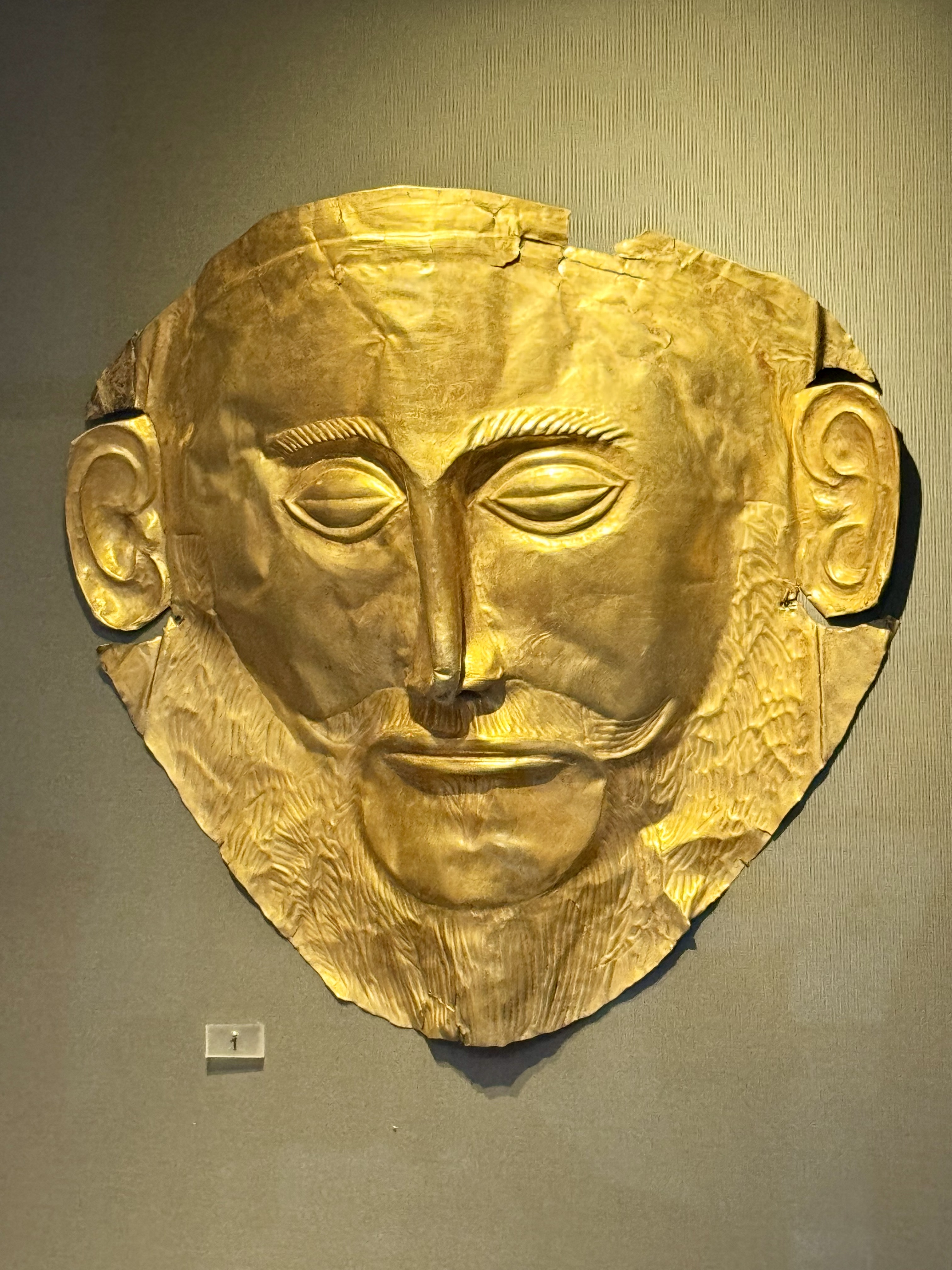
Not to be confused with the Acropolis Museum that focuses soley on the Acropolis, the National Museum has artifacts on display from throughout Greece.  In particular, they had great exhibits on Mycenae, which we will visit later on our trip.  This photo is of a gold Agamemnon Death Mask found at Mycenae.


Panathenaic Stadium:
Stadium that hosted the first modern-day Olympics in 1896.  It is constructed entirely of Pentellic marble making it the only all-marble stadium in the world.


St. John of the Column Church:
This tiny Byzantine-era church was built on the site of a former shine to the Greek God Asclepius.  The column remained from the previous shrine and the church was built around it. 


Santorini

We were up at 4am again on Wednesday for our second island day trip, this time to Santorini.  We're able to catch an express bus to the airport about a 20 minute walk from our apartment.  On the return, we take the train/metro back to an even closer spot next to the Acropolis Museum which is only a 5 minute walk from the apartment. The metro doesn't run early enough in the mornings to take both ways or else we'd be doing that.  Total cost for the round trip is only 15 euros, which is way less than a cab and just as quick considering the traffic.

Fira
Santorini is a very popular stop with the cruise ships, to the point of overcrowding with loud complaining from the locals. This year there have been protests around overtourism and Santorini has been one of the most talked-about places where this is a problem.  Fortunately, we're here during off season and there are no cruise ships.  Flying to the islands has been a huge time saver.  Today, it was a total of 35 minutes from the time our plane pulled out of the gate in Athens to the time in pulled into the gate in Santorini.

Caldera Beach
The main two towns on Santorini are Fira and Oia.  Fira is where the cruise ships pull into and Oia is known for its fabulous sunsets where many people (me included) take the iconic Santorini photo.  Both towns feature the same style of mostly white buildings and blue-domed churches, and they are both on top of the cliffs with sheer drops down to the water.  Cruise ship passengers have to make a steep climb from the port up the hill with many switchbacks or opt to take a donkey ride.  There is also a cable car which is great, but I understand from my research it can be a very long wait time when lots of ships are in port.

Akrotiri Archaeolgical Site
Because we had a rental car we were able to drive and see the island from one end to the other.  We visited the Akrotiri Archaeological site which has only been excavated since the 1967.  Akrotiri was a Minoan town that befell the same face as Pompeii in Italy in that it was buried in ash from a volcanic eruption.  Radiocarbon dating estimates the eruption to have occurred approximately 1600 BC.  The entire site is still being excavated and is totally under roof and enclosed to protect it from the elements.  We then drove to the southern point of the island to see the Akrotiri Lighthouse.

Caldera
The volcanic eruption that buried Akrotiri created a huge caldera which we drove along as we passed through Fira up to Oia.  Oia is mostly pedestrian with narrow alleys as you work your way down the cliff side to the various shops, houses, and stores.  It is very picturesque and easy to see why it's so popular.  While most things in Oia appeared to be open, Fira seemed like a ghost town with many restaurants and shops closed for the season.

Santorini was great, but I wouldn't want to visit with cruise ships.  With so many the narrow lanes, I can only imagine it's wall to wall people.  Coming in the off-season and having a car was much preferred for our style of travel.  We caught all of the sights we wanted at a leisurely pace and got the iconic photo without jostling with lots of other people.  That's a win.

Iconic Photo of Oia


Thursday, November 14, 2024

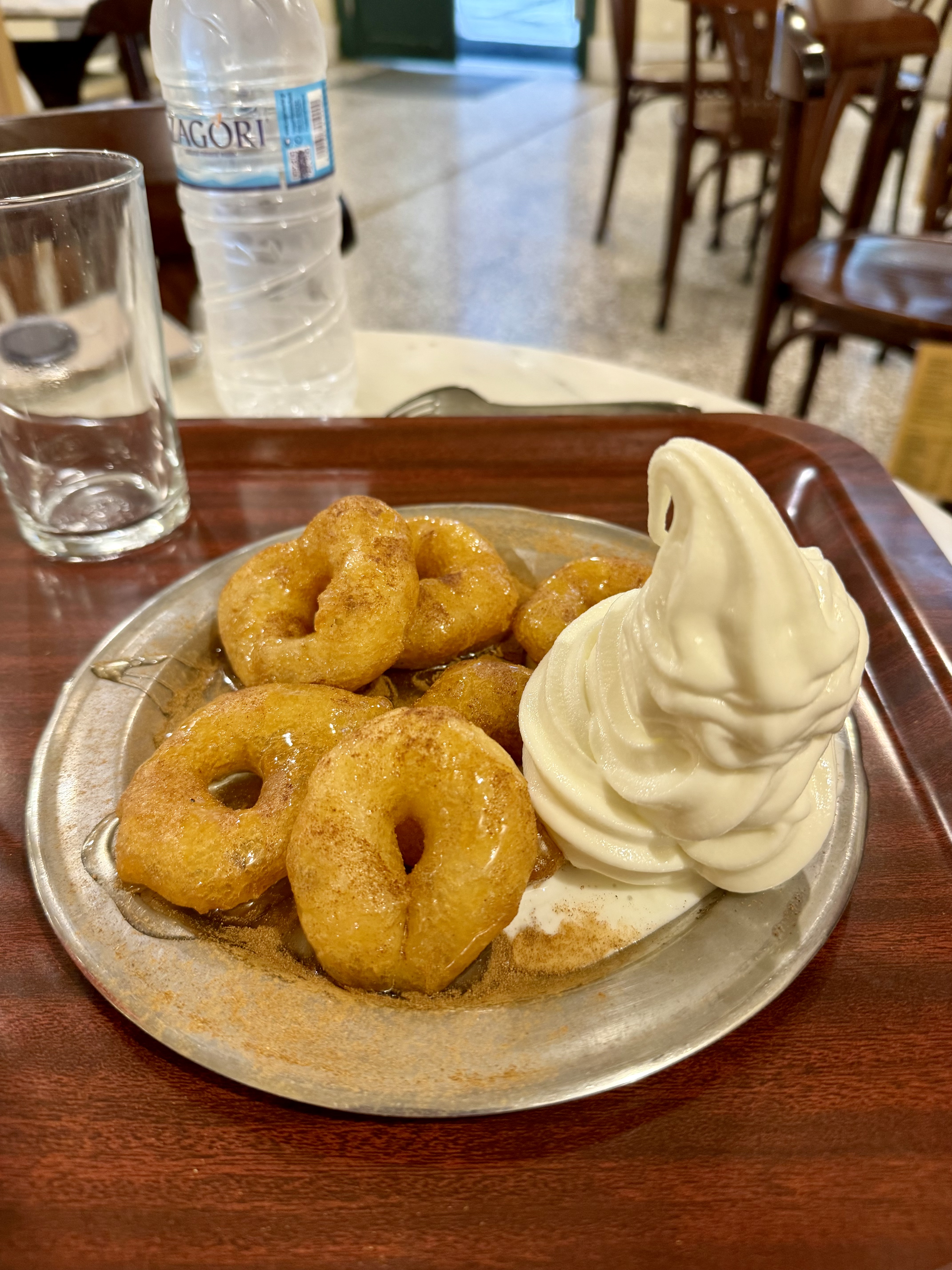
Mmmmmm....doughnuts.

One of the places Wendy found for us to visit was the Krinos doughnut shop.  Apparently, it's an Athens institution, having served up its light and airy fried doughnuts since 1923. They drizzle them with honey and cinnamon, and if you want, you can top it off with ice cream.  Did we say no to ice cream?  Of course not.  Breakfast of champions.  It's a good thing this place is across town from our apartment or else we'd be visiting a lot more than our one time.  It was delicious!


Rhodes

On Monday, we took the first of what will be three day trips to different islands in the Aegean Sea.  Our first destination was Rhodes.  Taking ferries between the islands is very popular during the summer time and is a main method of travel between them. However, it's the off-season and the ferries are infrequent and take more time than we have to give.  Instead, we decided to stay in Athens and take day-trips with short flights back and forth.  This is working very well and we only need to take a backpack for the day and we can leave our luggage behind at the apartment.

Rhodes is both the name of the island and its main city, which is a UNESCO World Heritage Site.  From the entrance sign:

"The medieval city of Rhodes is a unique example of a particular medieval architectural style of the period of the Crusades that combines byzantine, french and spanish influences. With its frankish and ottoman buildings the medieval city of Rhodes is an important ensemble of traditional human settlement, characterized by successive and complex phenomena of acculturation. Its impact during the period of the Knights (1309-1522) affected Eastern Mediterranean basin at the end of the Middle Ages."


Wendy inside the moat
Rhodes was originally a walled-city, typical of the time period to protect against invaders.   The walls remain intact as they were originally, giving Rhodes the reputation as having the best-preserved ancient walls in the world.  The old town historic center remains within the walls as the modern city has long outgrown them.  We toured the Palace of the Grand Master, originally built in the 7th century as the citadel of the Byzantine fortress.  
At one end of Street of the Knights

There were a number of major modifications made in the 14th century.  The first floor collapsed from a nearby explosion in the 1800s and somewhat "arbitrary" reconstructions were begun in the 1930s. There were a number of mosaic tile floors still intact from the era of the original 7th century construction.

Besides visiting the old walled city, our other major activity on Rhodes was visiting the Acropolis in Lindos, about an hour southwest of the city of Rhodes.  The Lindos Acropolis dates back to 6th century BC when the first monument was erected -- the Temple of Athena.  The acropolis was used as a fortress by successive empires including the Byzantines and the Ottomans. We had to walk a steep path to access the top of the Acropolis -- the same path that has been used for centuries.   Looking down gave us sweeping views of sea.

The village of Lindos is virtually car-free, with the main central area completely pedestiran with narrow alleyways to navigate.  One of of the coolest things about Lindos were the many floors and sidewalks that were mosaics, but instead of tiles, they used sea rocks.

A great example of the sea rock mosaic

We were up at 4am and didn't get back to the apartment in Athens until 10pm.  A very long day, but also a very rewarding one.


Tuesday, November 12, 2024

There's more than just the Parthenon

Temple of Hephaistos
After a great day on Saturday touring the Acropolis and seeing the Parthenon, we spent Sunday touring other ancient sites in and around the Monastiraki nieghborhood.  In addition to the historic sites, the neighborhood is known for its lively flea market and the best gyros in town.  Many of the sites are in and around the Ancient Agora -- all of the most important public buildings and temples of the administrative, political, and religious center of Athens were built here.

Temple of Hephaistos
The Temple of Hephaistos is the best preserved structure in the Ancient Agora.  It was started in 450 BC -- a little before the Parthenon -- and dedicated in 415 BC.  Like the Parthenon, it is a classic peristyle temple which means the building is surounded by columns.  It's approximately half the size of the Parthenon.  Hephaistos was the god of blacksmiths, metallurgy, artisans, and the like. 

Stoa of Attalos
The Stoa of Attalos was an ancient shopping mall.  The ground floor once held about 20 shops and its covered walkways protected shoppers from the elements.  It was built circa 150 BC by King Attalos II of Pergamon (now modern day Turkey).  This stoa was made from the same marble as the Parthenon.  The original structure was lost centuries ago, but this is a faithful reconstruction built in the 1950s and houses the Ancient Agora museum.  The museum showcases many artifacts excavated here. 

Church of the Holy Apostles
The Church of the Holy Apostles was built around 1000 AD during the era when Athens was controlled by the Byzantines. Architecturally, this church was the prototype for later Athenian churches with its central dome and four arms radiating out forming the shape of a Greek cross.

Outside of the Ancient Agora but in the same neighborhood, we saw ruins of Roman Athens. The Roman Forum was the commercial center of Roman Athens.  This open-air plaza is a typical feature of every city Rome conquered.  Wendy and I are standing amongst portions of the columns still standing. Hadrian's Library still has several large columns remaining from the 100 it had originally.  It was a large rectangular building that was a cultural center during the Roman period with a library, art gallery, and garden.

Hadrian's Library

This was another enjoyable day spent seing the ancient sites. The crowds at the Acropolis and Parthenon were significantly larger than at the sites we toured today.  I suspect that is typically the case which is a shame since these sites are equally rich in history.  


Bird's Eye View


My favorite picture from Athens (so far 😀).  Late afternoon when the Acropolis closed and all the people are gone.  Love my drone.