Tuesday, November 12, 2024

Holy Church of Hagia Dynamis

On Sunday morning, the Athens marathon was taking place with tens of thousands of participants.  The race follows the ancient route from the town of Marathon into Athens and ends at the Panathenaic Stadium where the first modern Olympics took place.  With many streets closed and heavy traffic, we set out on foot for the Monastiraki neighborhood for more ancient sites, the main cathedral and a few other churches.  I'll write about the other sites in a different post, but I want to focus this on our best local experience during this trip.

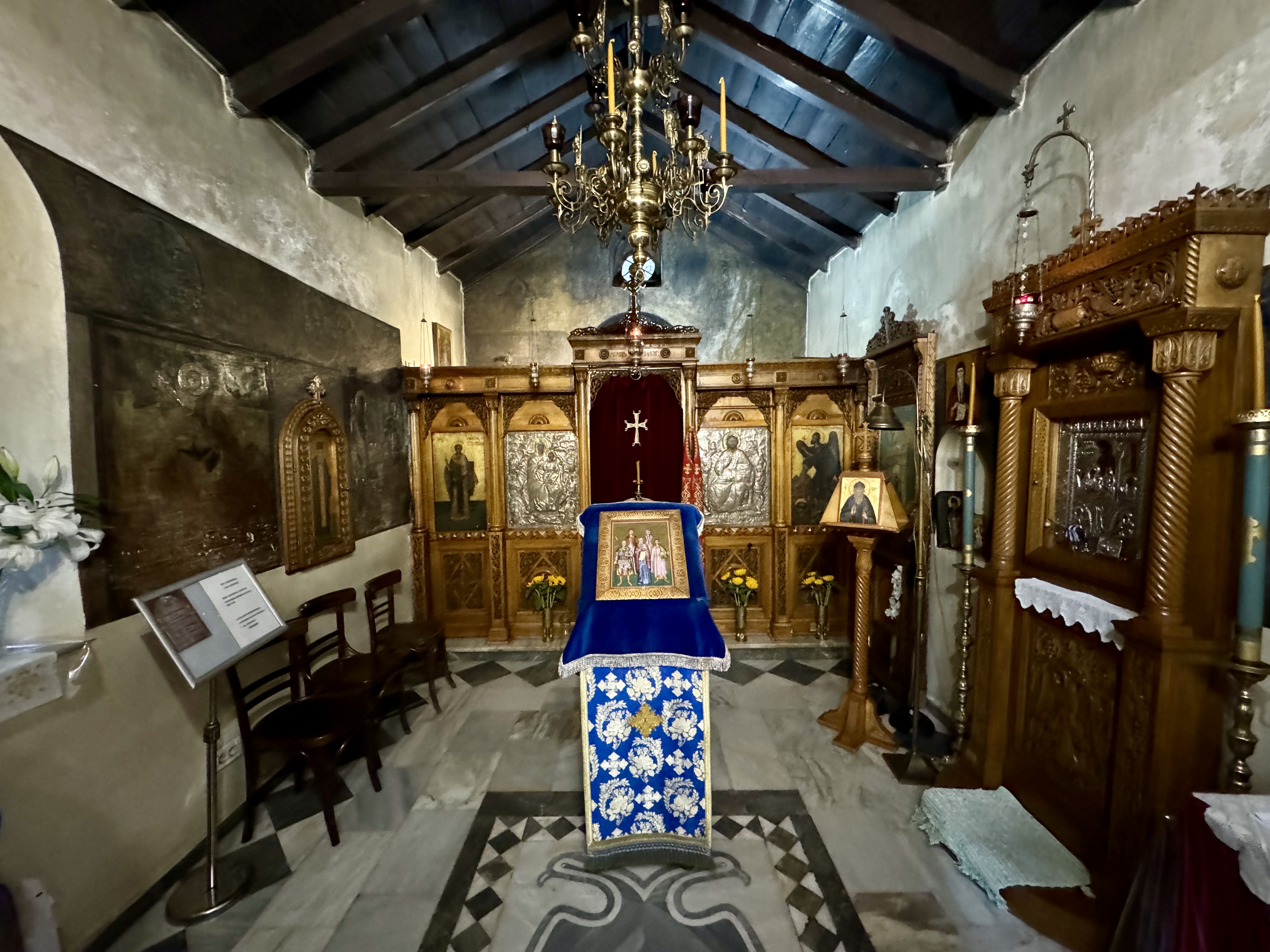
The Holy Church of the Hagia Dynamis is old and tiny.  In fact, modern Athens has built up around it, and in the case of this church, literally over it as well.  The church couldn't move, so they just built the modern high-rise building around and over it.  As Wendy was taking my picture showing just how tiny this church is, the caretaker emerged from inside. She invited us in to see the interior.

She was very proud of her church and told us some of  its history as well as showed us several icons.   She spoke French as well as some English, both of which were far superior to our understanding of Greek.  Between remembering some of our high school French and her English, we were able to communciate just fine.

She invited us to light a candle which is very common in the Greek Orthodox religion. When I offered to pay (as is customary), she wouldnt hear of it.  This is my gift to you and to welcome you to Greece she said.   We asked to take a photo with her to remember this moment.  She declined.  However, if you look closely at the picture above with me standing next to the church, we can see her when she first exited the church and greeted us.

Perhaps this was serendipity.  Perhaps this was a little God-wink.  I do know that what we saw and felt today is rarely experienced by others as this church isn't able to be open like others in Athens.  For that, we are thankful.

Saturday, November 9, 2024

Acropolis and the Parthenon

This morning we went to the top of the Acropolis.  The Parthenon is undoubtedly the most important and well-known structure there.  When Mona and I went to Athens in 2018 with her parents I wrote about the Acropolis and Parthenon in this blog post (click here). Rather than repeat a lot of the same things about the structures and history, it's easier to refer back to that post for a more detailed description and photos. Besides, it's thousands of years of history and not much has changed in six years 😀.

However, there are other structures and ruins along the slopes of the Acropolis that Mona and I didn't do with her parents, but Wendy and I did today.  

The largest of these was the Theater of Dionysus.  The earliest theater constructed at the site was made of wood but didn't last and subsequent theaters and additions were made of stone.  This was an outdoor theater that likely could seat close to 20,000 spectators.  Unlike the Odeon of Herodus Atticus which still hosts theater and concerts today, the Theater of Dionysus did not survive and is very much a site in ruins.

However, we can see evidence of its large size and how its location on the slopes was very well suited as a theater.  The photo to the left is of a model that depicts how the theater likely appeared at its peak.


The final photo shows the "expensive" seats down front, with seat backs and inscriptions.  I'm not sure what the inscriptions say, but perhaps the theater had sponsors just like theaters today, and in return you had a seat with your name on it. Maybe?  Maybe not.  Either way, it's still a great seat.

Friday, November 8, 2024

Hello Athens

We've left Crete and made our way to Athens.  It was a nice and quick 35 minute flight followed by a two-hour taxi ride due to traffic and road closures.  We're in our apartment in the shadow of the Acropolis.  This is the view we get to enjoy from our balcony during our week here.  Maybe we should plan on spending more time at the apartment 😀


Final Heraklion Sights

Our whirlwind two days in Heraklion have come to a close and we're off to Athens and the mainland.  We did catch a couple of the churches that were within walking distance of our apartment.  Here are a final few photos:

Church of St. Titus


St. Titus interior


Cathedral of St. Nicholas

St. Nicholas interior


Venetian Heraklion

Venetian Loggia
The Archaeological Museum an the Palace of Knossos were all about the Minoans.  Long after the Minoans left, Crete was controlled at various times by the Byzantines, Ottomans, and Venetian empires. Architecturally speaking, the Venetians gave Heraklion some of it's best architecture.


Loggia inner courtyard
The Venetian Loggia was a place for meetings, recreation for dignataries, and generally for the prominent and wealthy citizens of what Venice referred to as Candia (Heraklion).  It was constructed between 1626 and 1628. Now housing the Heraklion City Hall, the building is actually a very accurate replica built starting in the 1960s.  The reconstruction received the Europa Nostra Award which recognizes outstanding heritage achievements.


Bembo Fountain
Bembo Fountain was built between 1552 and 1554 by Captain Gianmatteo Bembo who also built the first acqueduct to serve Heraklion.  It contains a headless female statue as well as a Venetian Coat of Arms. Unfortunately, it is no longer a working fountain.  The Morozini Fountain was built in 1629 by Francisco Morozini and is just a block or so away from the Loggia.  It has four lion heads in which water comes out the mouths,
Morozini Fountain
although they were not on when we saw it.  It does appear to still be a working fountain.

Finally, the largest Venetian structure we visited was the Rocco a Mare (Sea-Rock), the fortress which has guarded the port of Heraklion for centuries. Today, it's a lovely place to visit and see panoramic views of Crete and the Mediterranean Sea, but I can only imagine how imposing it seemed to sailors long ago.

Rocco a Mare


Thursday, November 7, 2024

Palace of Knossos

We managed to make it through most of the day yesterday without napping.  Wendy made it until about 7:00pm and I made it all the way to the late hour of 8:30pm.  Woo hoo!  I then managed to sleep 11 hours and woke up to my alarm at 8:00am this morning. Hopefully, that has provided the reset we need to quickly adjust to the time and avoid jet lag.


After getting a taste of Minoan history at the Archaeological Museum, we spent our morning exploring the Palace of Knossos.  The palace was a short 15 minute ride on the #2 line of the public bus network, and it dropped us off right at the main entrance.

The Palace is the largest in Crete and was surrounded by an extensive city.  The site of the palace was first settled in the Neolithic period beginning circa 6700 BC.  The first palace was built around 1900 BC in what is referred to as the Old Palace Period.  It was destroyed about 200 years later and a new palace was built in its place in 1700 BC (New Palace Period).

British archaeologist Sir Arthur Evans was the main excavator of the site.  He interpreted the function and spaces in the palace and gave them names that reflected their uses.  He also performed some interpretive reconstructions that some have criticized as not necessarily accurate and certainly not representative of the materials and construction techniques that would have been used by the Minoans.  The names given to structures and spaces are still used today, although subsequent studies and excavations have cast doubt on some of Evans' interpretations.

Throne Room
Regardless, the Palace was a center of political, economic, and religious authority.  There are a variety of architectural elements and the many antiquities on display at the museum that were found here support this belief of the Palace's importance.  The Palace continued to be used after 1450 BC when the rest of the Cretan palaces were destroyed.  This is the time period that the Mycenaeans from mainland Greece took over Crete and it is believed that Knossos was used by the Mycenaeans until at least 1380 BC when it likely began to decline.

Royal Road
The other really cool site in Knossos next to Palace is what's called the Royal Road.  It was the main east-west artery.  It consists of a central strip containing a double row of raised limestone slabs.   The side sections were tamped earth with pebbles and small rocks, and there was even a stone drainage channel that ran the length of the road.  Very impressive for a road built 3,500 years ago. Even more impressive is the fact that this road could still be used today...but perhaps only one-way since our vehicles are just a bit larger than what they used back in their day.

Wednesday, November 6, 2024

Not just ancient history, but REALLY Ancient history

World History is not necessarily a favorite subject growing up, especially Ancient World History.  In America, we typically focus on Greek and Roman history as they were the most advanced civilizations during those eras.  We learn about the Greek philosopher Socrates or Roman Emperors like Julius Caesar.  But what about the Minoans?  You've never heard of them?  I hadn't either until we started planning this trip.  It turns out the Minoans pre-date the great Greek and Roman periods of history -- by a lot.

We arrived in Crete in time to visit the Archaeoligcal Museum of Heraklion before it closed.  It has extensive exhibits of artifacts from the Minoan period that were found throughout Crete.  Minoan is derived from Minos, king of Knossos in Crete in Greek mythology.  The Minoan world started during the Neolithic period circa 7000 BC, continuing through the Bronze Age, and lasted until about 1100 BC.  Knossos is considered to be the oldest city in Europe, older than Athens and Rome, although now it's just a memory.  

A few of the ancient artifacts we saw are pictured here:


The Bee Pendant -- famous gold ornament from Malia on the coast of Crete (1800 - 1700 BC)


The Bull-Leaping Fresco from the Palace of Knossos (1600 - 1400 BC)


Portable ovens (4500 - 3000 BC)


Kamares Ware Pottery (1900 - 1700 BC)


Vasiliki Ware -- various wine jugs and tea pots (2400 - 2200 BC)


The ruins of the ancient Palace of Knossos are just a few minutes south of Heraklion and we will visit this site tomorrow.  Looking forward to learning more about Minoan history.